Thursday, August 31, 2006

License to SNATCH


Panel One: A classic Garfield last-panel-reveal joke. These usually sustain our interest because of a character's inexplicable, strange behavior, or an out of place, unfamiliar element. Today we join the action midstream, and all the reader wonders is "what is Garfield taunting Jon about this time?"

Once we find out the answer and reevaluate the story, a new question is provoked: did Jon come home from the DMV and ask his cat's opinion of his new photo? Well of course he did.

Panel Two: Jon's arc through these three panels is not the simple embarrassment of a bad driver's license photo, but the dual-motivated surprise and hurt of ego deflation and betrayal by a confidant. Jon obviously thought the picture was either flattering, requested damage-assessment, or had handed over the card for unrelated inspection, and reacts as if not expecting this jarring outburst from Garfield. As Tweetie once said, "he don't know me very well, do he?"

Panel Three: Garfield's ironic appreciation of the photo because it embarrasses Jon has further weight than simple insult, because Garfield makes no effort to improve his personal appearance. Though the cat is outrageously vain, the quality is baseless pride, entirely delusional and narcissistic. When Garfield teases Jon about the photo, the taunt carries the implicit message that since he could not be wounded in the same way, Garfield is laughing at. Not with.

Also Garfield seems to inflate in size for no reason.

Wednesday, August 30, 2006

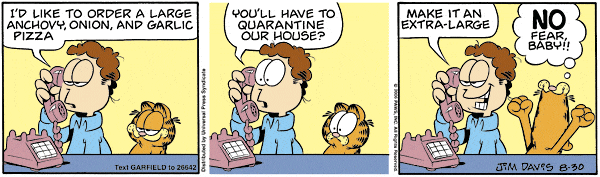
L'Ârge d'order of Pizza


Garfield's "NO FEAR!" cheer, a proclamation of true grit normally applied to sporting contests and dangerous living, is incongruously applied to two guys who are going to eat as much gross pizza as possible. In the joke-logic world, the pizza toppings are so disgusting, or will render Garfield and Jon so smelly, that they actually will be a danger, and arguably gorging yourself on melted cheese is not the safest of dietary choices. This isn't actually far removed from normal Guy Behavior, where eating and drinking contests, and feats of consumption fuel good times and liver problems alike, all the time.

The slight difference is that Jon and Garfield, for no reason besides sheer contrarian mischief, decide to go for broke with their antisocial behavior. What else is there to do when your personal habits and desires — be it nasty pizza toppings, bad music, cigarettes, weird haircut — are being attacked? Even if social standards require only the smallest of personal compromise? Even if the reasons to cooperate are for entirely logical, understandable reasons? Garfield advises not only to let one's freak flag fly, but to crank up Here Comes Garfield and blow smoke in the face of oppression. Of course, this only applies when personal appetite is at stake. This is less War on Freedom than "Don't Crowd Me".

Show me the ultimate end-product of American individualism, and I'll show you a cat with garlic breath.

Tuesday, August 29, 2006

On Top of the Table and Dreaming


The key to Garfield's personality is not that he is simply lazy and grouchy, but his determination to be as lazy as possible. He doesn't just space out like a normal person, but plans and makes an effort to space out. Understanding this is critical to appreciating Garfield in general. It's not boring, but a hard look at what boredom means, and the damages and comforts we may find there.

As the joke in a newspaper comic strip, Garfield examines what audiences demand in popular entertainment; it should be new and thrilling, but please, more of what we're already familiar with. It also reminds us of the special pitfalls of writing Garfield: when the point is that nothing ever happens, how does one continually engage an audience?

"I want to do absolutely nothing, but I want it to be a new absolutely nothing." The paradox is the joke, but Garfield's dilemma makes a sharp observation about a fundamental reason people are miserable. The unresolvable, eternal tension between desire for excitement and need for comfort. Garfield mocks the heightened conflict of other fiction by inventing a hero whose irritation threshold is so low that he can't help but have his plans foiled. What happens to a life that pursues ennui believing it to be fulfillment?: eventually, Garfield sees the ricocheting effect as he stares into the void; he runs out of dreams. In Garfield, the universe itself is so fundamentally barren that even a creature who bores himself for entertainment is frustrated in his effort. The oh-so-Garfield response to this ultimate spiritual crisis?: "Nuts."

Monday, August 28, 2006

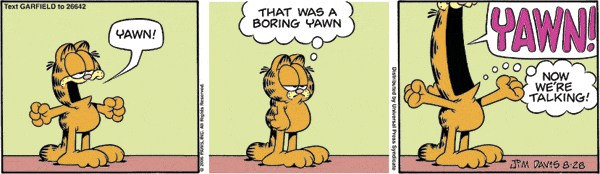
Mouth Wide Open


Besides the awkward necessity of two text bubbles emerging from the same character in panel 3, here's a primo joke about Garfield's personal standards. He places an importance on living with flare and style over the remarkableness of achievement, and even his lethargy must be remarkable, world-class laziness. Likewise, though characterized by inactivity, Garfield selects to participate in only those tasks he can perform in excess and with mastery. This tendency in Garfield has always reminded me of Oscar Wilde, who not only made Lifestyle an artform, but whose enduring legend outweighs his writing in quantity and arguably in import.

Garfield is the rare iconic American character known entirely for his attitudes and opinions, and barely at all for his adventures or the stories that he is involved in. This entire blog is dedicated to understanding what it means that a nation embraces a character that mirrors and celebrates cultivated gluttony, laziness and meanness. Today we see how Garfield twists the Puritan work ethic to suit his own useless ends: a job is only worth doing if you can do it right, so make sure the things you're good at further your self interests. May we all be as spectacular at displaying our apathy as Garfield.

Sunday, August 27, 2006

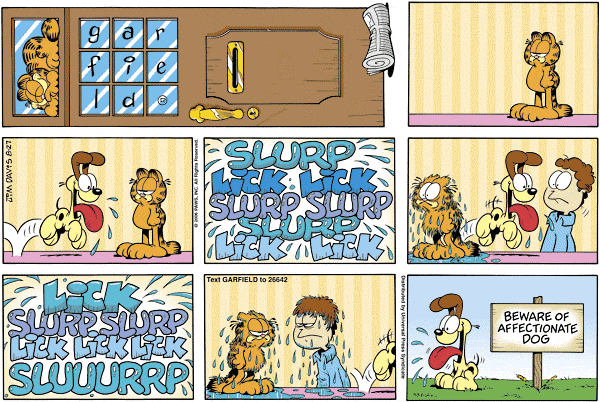
Dog Drool Afternoon


The basic dynamic: Odie's expression of unconditional love is overzealous and physically repulsive, and inspires not appreciation but misery. In the Garfield-verse, counting on others for happiness is an unwise proposition, and moments of joy tend to be born from self-reliance and/or self-indulgence. Total obliviousness to others' feelings is a partial explanation of Odie's happiness; ignorance may be bliss, to a degree, but it also gets him put out of the house and branded as an outcast. The other part is simply rushing headlong into what he wants to do. Lest we think Garfield endorses this kamikaze happiness as a successful coping mechanism, note that there is no character as put-upon, loathed or physically abused as Odie. Closer to the truth is that Garfield tells us it's unnatural and stupid to be so optimistic, and in episodes like today's, it is disgusting as well.

Point of consideration: Odie's primary job is foil to Garfield, perpetual optimist to the pessimistic cat. But another aspect of Odie's character is a distilled mirror-version of Jon, specifically Jon's approach to dating; Arbuckle throws himself at women with supreme confidence.

A Note on Cartooning: One of the strip's specialties is suppressing the moment of physical comedy. This is certainly not a hard-and-fast rule, but Davis frequently opts to portray those panels of aftermath, or focus on a character's reaction to off-panel action. Today the scenes of Odie's tongue actually making contact with others are hidden behind sound-effects so large they blot out the action. Add to list of What's Awesome About Garfield: it solves story problems and invents joke structures with techniques specific to the medium, without drawing attention away from the jokes the innovations are supposed to service.

What better panel to advertise the Garfield goodies available via cellular phone, than the image of two angry, miserable characters quietly seething and dripping with saliva? Probably none but the first panel proper, in which Garfield stands motionless and staring into space.

Saturday, August 26, 2006

Mother, Jugs and Spuds


Jon's mother, while oblivious or obstinate on most topics, responds with such exaggeration to news of Jon's steady dating that the reader is nudged to remember exactly how monumental a development it is. By keeping Mom off-stage, we're allowed to read the entire spectrum of possible responses, from "I am happy; finally my son will begin a family" to "the bottom has dropped out of my reality". Because all that we know of Mrs. Arbuckle's reaction is that her circuit breakers have been tripped - she could be shocked, delighted, etc. - perhaps the reactions we personally migrate towards can tell us something about our own responses to Jon, or even about our relationships with our own parents and how we feel they view us.

Another dimension to Jon's mother's surprise is underlined by the secondary joke that the Arbuckle family is so cornpone that there is always a big helping of mashed potatoes in the immediate vicinity. The generational and cultural gap between Jon and his family likely means Jon's prolonged bachelorhood has seemed even more extreme to his rural parents.

Garfield of course has zero interest in either Jon's love life, or Arbuckle family business, and latches onto one tangential idea for his own personal punchline, "I've had dreams like that." It's a double-barrel joke, telling us A) that the Arbuckles are so boring/ Garfield so self-absorbed that he's not even paying attention, B) Garfield's gluttony extends into a deeply confused place in his subconscious. It's one thing to have a wish-fulfillment dream about diving into a swimming pool of mashed potatoes, or eating your way out of a cave made of mashed potatoes... but fainting unconscious into food means that in the dream you're not even eating, but being covered, smothered, consumed. This wiggles past defiant indulgence, or even food addiction and into fetishism that will take expert psychologists with more serious training than I to untangle.

Optional Reader Activity Worksheet: Call your mother and inform her that Jon Arbuckle has a girlfriend. What is her response? Into what food does she pass out? Will real cats even eat potatoes?

Friday, August 25, 2006

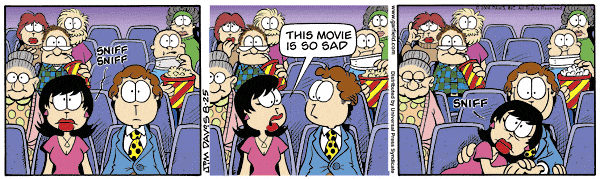
Cry for Jon


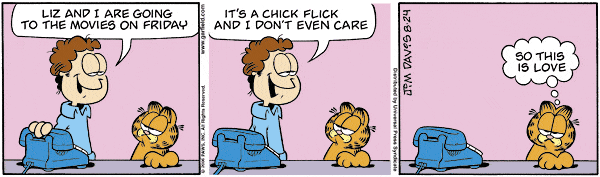
Two particular points of interest today. Garfield regularly trades in schadenfreude gags, wherein Garfield takes pleasure in Jon or Odie's pain. This visit to the movies provides a sweet-natured and related counterpoint. It's not Liz's sadness that gives Jon happiness, but her need for comfort, which is a natural byproduct of sadness. There's nothing insidious about taking pleasure in the ability to be there for a someone in need, but it is a minor human failing we do not usually admit. In more dire circumstances it is better known as the sin of pride. But Liz is not hurt or sad on a soul-shaking level - the reasons we attend weepy movies are the reasons the Greeks produced tragedy, and ultimately cathartic; the audience in their own way is happy because of their willful immersion in superficial sadness. Because of this we aren't concerned that Jon's exhibiting sociopathic behavior and feeling gleeful while others weep, rather there's a wistful little joke about a man unaccustomed to a social touch feeling his way in the world of interpersonal contact.

Audience Reaction Studies
Whatever the movie is about, surely a bittersweet romance, a real-life drama is happening in the theater, and goes unnoticed by all but the knowing and/or leering elderly woman. The rest of the audience is rapt, and from the neckless soda-sucker to the neck-braced popcorn-eater to the fright-wigged aerobics instructor, in true Garfield fashion, no one looks like they're enjoying themselves.

Besides Liz, who I hope is talking at normal volume during a movie only for expositional purposes, no one is communicating the emotional effects of the film so well as the redhead in the turtleneck. Cartooning crowds of ugly people without distracting from a simple joke is a tricky tightrope. Her one-handed pantomime makes her the only audience member vying for our attention in the packed frame. Also I'm pretty sure her date is one of the Fabulous Furry Freak Brothers.

Thursday, August 24, 2006

So This is What Makes Life Feline...


As a Movie Guy, I admit I don't think there's anything inherently wrong with any genre, even the "chick flick". The genre formerly known as "women's pictures", with a long and illustrious history from Now Voyager to Love, Actually, may not be Jon's ideal Friday night entertainment, Davis hasn't gone out of his way to identify a specific torturous film. Jon is indeed the target audience, a young man on a date, and even if he doesn't find something to enjoy in the movie, he may make good by Liz and the genre is pretty inoffensive anyhow. We've seen Jon mention a love for children's films, and settle in for an evening with Brigette Bardot movies; while there's plenty to sustain male interest in a Bardot picture, most of them aren't Dude Movies par excellence. Choosing a date movie is tricky business anyhow, and most would agree a healthy ability to suck it up and let your date indulge their interests is a good thing. I spend this time to illustrate that it's not Jon's behavior at the heart of the joke.

Garfield witnesses one of the small compromises that happens in all relationships, and gives it a thumbs-down. Granted it is not just Jon's willingness to spend Friday night at a movie he doesn't want to see in exchange for time spent with someone he cares about that Garfield views as emasculating, but Jon's blissed-out zombie state confession that small nuisances don't bother him right now. Garfield's stubborn self-centeredness causes him to draw a hard line in all things: the cat will never do anything he does not want to do, and when his back is against the wall he will sabotage the situation (e.g.- constantly abusing Odie) or complain about it (e.g.- everything Jon does every day). Garfield cops a song title from Cinderella for his sarcastic refrain. It is a song which celebrates approximately the state in which Jon finds himself. Days like this both the guys might be right, but the thing about cynics is they think they're realists.

Wednesday, August 23, 2006

The Naked Kitty


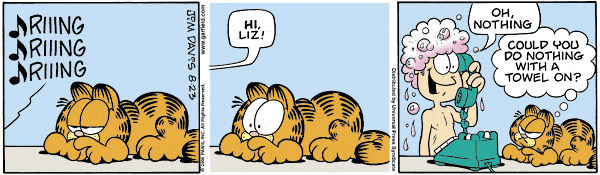
A fine result of Jon and Liz's recent dating developments is it allows jokes on the topic of Old Friend Hates Buddy's Changes in Behavior Over Significant Other. This plays beautifully in Garfield because the characters and relationships are already set up for it. Jon's desperate and eager attempts to please a woman at all cost to personal dignity and comfort flow naturally into a man totally pussy whipped, even by a woman making few if any demands. Today all Liz has to do is call him, and Jon bends over backwards to be attentive, even as he brazenly violates his friend's comfort zone and lies to Liz. It's also a sweet observation about how exciting new relationships are, but in Garfield it's always tinged with the ominous undertone: Jon overcompensates because he's love-starved.

Garfield is just as naked as Jon, of course, but chalk it up to joke logic. Besides, it's funny that Garfield would complain about having to look at Jon's scrawny, soapy body, finding it more disgusting than his own robust physique, that he holds Jon to certain human standards of decency while he allows himself to pick an choose. Even better it tells us something about mutual understandings in Jon and Garfield's domestic situation. Maybe not much, but at least that Garfield has divested himself of at least one more normal cat behavior, that mysterious love of staring solemnly at their naked owners.

Also Garfield's phrasing "could you do nothing with a towel on?" holds the awareness that it may be a given that Garfield is a chronicle of inactivity, but at least it's not usually waving its crotch in your face.

Tuesday, August 22, 2006

Mr. Sar-Jon-icus


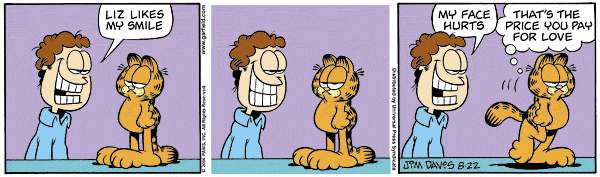
Jon's Mistakes:
-Liz may like Jon's smile, but not that smile.
-Believing he should modify fundamental aspects of his behavior to please a woman.
-As long as he's bothering with an unnatural grin, to continue the grimace at home.
-Sharing any relationship problems, no matter how miniscule, with Garfield.

Garfield's Awesome Response:
We see characters with the same half-lidded expression nearly every day. It is the default facial expression for most Garfield characters, but it's amazing what a versatile utility player it is, and how subtly it can shade a character or moment. Garfield in panel one has to both look calm and normal next to Jon's frantic grinning. and express something like "I cannot feign too much interest, but as long as you're sitting here with a horrible Man Who Laughs look on your mug, and it's a given you're going to tell me anyway, we all might as well see how weird your explanation is." In panel two, the fourth-wall aimed pupils shift a millimeter: "You guys hear this?"

There's a world-wise truth to what Garfield says: being in love invariably causes pain, and it gets worse the harder you pretend to be happy all the time. Lest we mistake a lazy, intentional jerk for sage, ask what life experience Garfield has with romantic love.

Monday, August 21, 2006

Auld Lang Sigh


Yes, hoorah for those kind of girlfriends you see once a month. While I honestly don't think it's Jim Davis' intention for us to question the commitment of Jon and Liz's relationship, I do think it's funny that he's spent more strips talking about her than spending time with her.

Jon's excitement about the relatively distant future is not so outrageous. It is part of human nature to imagine the possible development of a fledgling relationship. Fantasizing that a couple might still be dating in five months is not necessarily ridiculous, and while Jon's bug-eyed expression is supposed to indicate that he has become overeager, it's not the soul of the joke. It is Garfield's inability and/or stubborn refusal to take interest in Jon's happiness. Jon often speaks to Garfield not just as a housemate, best friend, or confidant, but as if Garfield is part of his internal mental dialogue. The unrelenting cynicism sometimes functions as it's own celebration of bad behavior, sometimes as comic counterpoint to Odie's moronic glee, but against Jon it can run the gamut. Contained in Garfield's brief response is a healthy "reality check" for Jon, an observant lashing-out about the jealousy of friends towards a chum's new relationship, and perhaps best of all, unnecessary meanness for the sake of being the force of contrariness in this small universe.

Sunday, August 20, 2006

Peanuts, Featuring Fat Ol' Kitty Orange


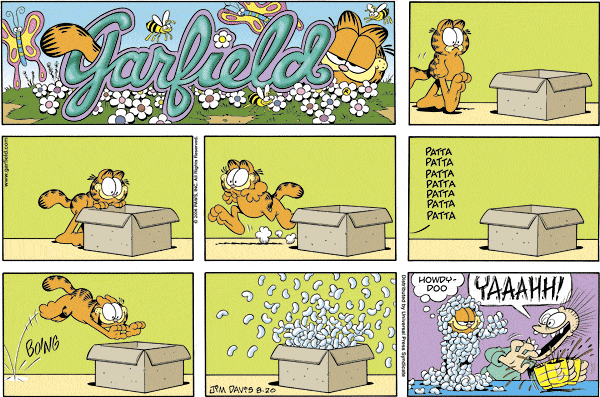
Title Panel: Why the springtimey reproductive-themed title panel when summer is ending and autumn's hand of death is soon to wrap the nation in it's chilly grip? Has Garfield's body become a flowery cursive rendition of his own name? Or is he lurking in wait hoping for some vicarious thrill as the insects go about their natural pollenation duties? The sly smile on his lips tells no lies.

Cat Covered in Packing Peanuts - 1: Garfield regularly practices the art of pantomimed physical comedy, especially on Sundays where seven panels of a cat sleeping on a table might be too much even for Gar-fans. A lot of cartoonists would have had an establishing panel of Jon calmly drinking coffee. Garfield knows it doesn't have to. Garfield has carefully established for a quarter-century that Jon is always sitting calmly at the table.

Cat Covered in Packing Peanuts - 2: Only because Garfield's anatomy is so grotesque would anyone be frightened. If a real fat kitty walked up behind you with white foam stuck all over his fur, a real person's brain would seize up and explode from seeing the cutest thing in the universe.

Saturday, August 19, 2006

How Does Your Garfield Grow?


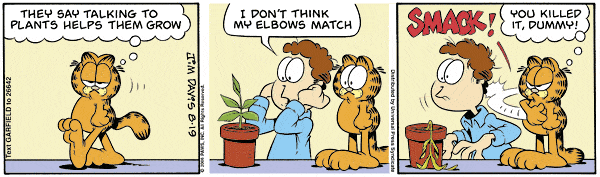
Panel One: Garfield is giving us gardening tips, one amateur horticulturist to another, though with his trademark dearth of enthusiasm. As usual, the strip flows smooth as honey, but after staring at it for a few minutes, subtle cracks emerge in the surface: is Garfield telling us about the benefits of talking to plants because he knows Jon is doing it, and is leading us to Jon for a demonstration? Or do the events happen to coincide? Garfield's surprise in panel two is partly because of the nonsense Jon is spouting, but couldn't Garfield see Jon a foot away down the table when he started walking and talk/thinking with the reader?

Answer: The rules of how light and sound travel between off-panel and on-panel spaces is variable depending entirely on the requirements of joke mechanics. We understand this intuitively about other laws of physics in comics, but the relationship between the on-panel and off-panel is so subtle the bending reality may not even register.

Panel Two: Jon's fear is funny for any number of reasons (e.g. - how much are elbows supposed to match? How can you tell when wearing a long-sleeved shirt? Why is this inspiring terror?), not least of which is that he seems to be asking for a second opinion from the plant. Since he usually gets a response from his housepets, maybe this isn't such ridiculous behavior.

Panel Three: Garfield: Actually mad that Jon hurt a plant, because he cares about plants? Disgusted that Jon has upset his gardening lesson for the reader? Or looking for any excuse to smack Jon? You decide.

Friday, August 18, 2006

Sit, Odie, Sit. Good Dog.


It is not ours to question the comic strip reality of a cat who has built scale versions of restaurant waiting line placards, nor of a dog who takes commands in written form, nor of that dog's anatomy which is so tortured that it is difficult to recognize at a glance that he is indeed sitting in the third panel. Joke Logic or no, it's a little counterintuitive that a restaurant-protocol gag should take place on top of a table in the house.

That Odie can read is pretty much the crux of the joke, because the associative gap between the meaning of "wait to be seated" and the command for a dog to sit is not very large. There's a second shade of meaning, in which Odie is so dumb he must be ordered both not to sit and to sit. Lord knows what he'd do if given no commands. Squat, maybe? Funnier is how Garfield shuffles through panel two, disinterested, though he is surely the one who made the signs. There are a few levels to these presentational strips in which Odie and Garfield mime a broad joke for us in vaudeville style. We are treated to the joke itself, the acknowledged artificiality of the format, and the self-conscious performances of our silent clowns: Odie with full confidence of the antique material, a happy, catatonic Fatty Arbuckle, and Garfield a weary Buster Keaton, stone-faced with disgust or defeat. The idea of an entertainer so lazy he doesn't care about the audience is a masterstroke. Your comedian is indifferent: laughing is your own job.

Thursday, August 17, 2006

Abre Los Olives


Jim Davis must find the idea of inanimate objects yodeling intrinsically funny. As an improbable image it works much better here than it did last time, though compared to what used to go down in Pee-Wee Herman's fridge, yodeling baloney is nothin'. It's always been a running gag that the Arbuckle refrigerator is a museum of horrors. I don't know that it jibes with Garfield's tendency to eat anything, including raw pancake mix and bottles of condiments, but it allows a lot of good jokes about the behavior of bachelor slobs.

Though Garfield and Jon are both ineffectual in their own ways, the performances demonstrate the great comic divide between them, even in attitudes toward cleaning the fridge. Neurotic, easily frazzled Jon looks so shell shocked he's not going to be able to confront the mess by himself. Garfield lounges in his most blatantly worthless signature posture. Normally Garfield posed on his back like this is reserved for gags about his laziness. At it's heart, that's what this is: though the rancid food situation has gotten well out of hand, he suggests procrastinating... for no reason. The usual excuse for procrastinating is that a problem will solve itself, or at least not worsen. Garfield fully acknowledges that the olives already have eyeballs in them, and will further mutate. And he just doesn't want to get up.

Fine. That's Garfield. Why does he care if Jon wants to clean the fridge himself? As long as you're going to try to be worthless as possible, the only way to truly achieve the goal is to drag someone down with you.

Wednesday, August 16, 2006

The Book I Shred


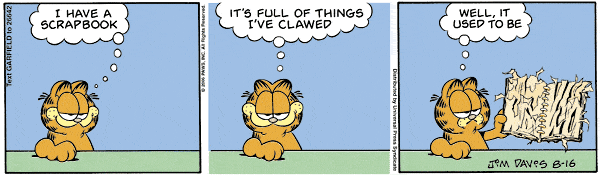
What happens to those who engage in destructive hobbies? The larger story of Garfield, who dives into the deadly sins with a show-off's flare, is of a creature defined by self-destructive interests. Conventional wisdom and practical observation tells us that the binge drinker, amateur pyrotechnician and drug user tend to destroy themselves in the process of indulging their interests. Garfield says as long as you can't dodge the bullet, you might as well run headlong into it.

So what becomes of the vandal, the pugilist, the sharpshooter, those hobbyists who specialize in defacing property, injuring others, causing destruction? They deal with the ephemeral in a special way, and today's strip ponders their dilemma. While they may have their trophies, equipment, periodicals and club T-shirts, the collections are snapshots of the event. As a collector, I ask myself a lot: is the true fun in having the rare book, record or Garfield T-shirt, or the thrill in the chase? The answer for the collector is "both". Garfield tries to mix the event-oriented hobbyist appreciation of the moment and the collector's aesthetic sophistication. Because his only way to relate to love objects is to do violence to them, Garfield ends up with nothing but scraps. Scraps, and something to brag about as master contrarian.

Tuesday, August 15, 2006

Party Jonster


There are two punchlines dueling for laughs but building on one another: Jon's indecisive dithering/enthusiasm for mundane chores and Garfield's disgusted evaluation of Jon's partying skills. Before Garfield's elaboration that chores and fun are unified in Jon's mind, Jon's dilemma is a basic one we all deal with daily. Objectively it is kind of funny that some nights you go out and goof off and some nights you stay home and do housework, and not only that but some nights you want to dust and vacuum. We're a social species, but a domestic animal as well, and maybe taking basic pleasure in activity like washing the dishes, scrubbing the bathtub and brushing our teeth keeps us from shooting ourselves in the mouth when we realize not-partying is really the majority of our time. It's a bleaker take on the idea behind Disney songs like "Whistle While You Work" and "A Spoonful of Sugar".

But even funnier than any of that are the first two panels. A man enthusiastically tells his cat he wants to party, as if the cat can do anything about it. And then he stares off over his shoulder, beaming, as if the party will spontaneously happen, or maybe sitting at the table with the cat was always going to be the extent of the party.

Monday, August 14, 2006

They Came for the Garfields and I Said Nothing


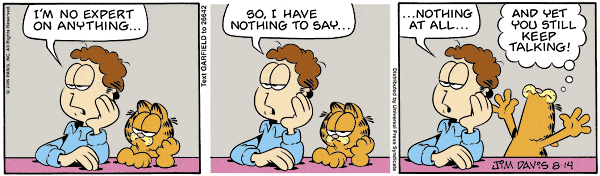
Very, very little popular media is as self-critical as Garfield. Though the strip is constantly berated by the amateur critic for monotonous artwork, and eventlessness writing, these are part and parcel with the themes and worldview of Garfield. It is the running gag and major character trait of Jon Arbuckle to be boring. The meta-gag of this strip is that maddening tedium is a job hazard of documenting the life of a dull man and his lazy cat. It's practically the mission statement. Garfield's conspiratorial glare at the audience in panel two indicates this is about more than the cat being Jon's irritated foil. The joke boils down to "WHY does this comic strip exist?", and that is a dangerous question for any art to ask.

The man with nothing to say and no one to hear it is a special Everyman archetype, entirely unidealized, unromantic. He's not just a funny dork character, but everything boring about our lives. If we wonder why anyone would bother writing, drawing, let alone reading, a daily check-up on a character whose essence is to be dull, the answer is that no page in the newspaper will give you real life like the three panels devoted to Garfield. The rest of the news is dedicated to documenting the "remarkable", the noteworthy, the extraordinary. The rest of our entertainment diet for the day is spent escaping life or pinpointing those moments that give it meaning. Those times when everything makes sense, those moments we remember until we die: those are rare and fleeting. Jon Arbuckle's daily struggle is the great wash of our lives in between those moments. Garfield isn't boring: you are.

Sunday, August 13, 2006

Kitten On the Wind


I have no problems with the commercial juggernaut of Garfield. My home obviously stores a fair amount of PAWS-licensed paraphernalia, and any accusations that Jim Davis has whored his kitten on the marketplace will fall on deaf ears. No matter how garish the ancillary merch gets, it doesn't effect the spiritual despair of the strip. If a Garfield pillowcase makes a some 6-year-old happy, I say no harm done in this case. In fact, I love that Davis' calculated attempt to capture America's imagination on a Snoopy-level involved morbid obesity, anger and relentless unhappiness, and the nation couldn't get enough.

And I don't doubt that when I'm done typing this, I'm going to download the daily Garfield-delivery application to my phone.

But for real, advertising it in the Sunday strip title panel!? Brilliant.

Windy Day
The structural effort of an explanatory punchline after six pantomimed panels is admirable, but honestly I think the art in the very first frame is too explicit to expect any reader to be confused about what is happening. What is disorienting is that the weather is such that a 27-pound cat is blown across the lawn but the wind does not cause a ripple across the surface of the birdbath. That and Jon's activity for the day, which seems to be standing around the living room wearing a red cap.

Negative interior decoration points for the poor attempts at Southwestern style. It always looks silly in Midwestern homes, and worse when it extends no further than one sub-roadside-truck-sale landscape painting.

Saturday, August 12, 2006

Jonny Crack Corn


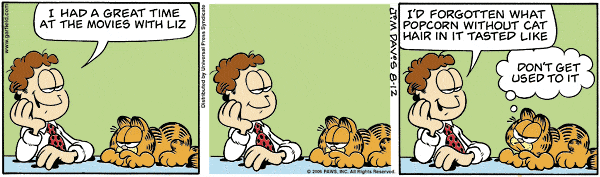
The dreamy look in Jon's eyes and general air of being out of it tells me Jon doesn't quite realize what he's saying. He thinks he's relishing the time spent alone with Liz, but his line of reasoning has nothing to do with the company at the movies. What Jon most enjoyed was time away from Garfield. It's actually fine, good and probably healthy, for Jon to realize this. It's a poor thing to subject Liz to, however, and the ideal result in a developing human being would be to make sure future dates are not just to get away from Garfield.

Part of how Garfield asserts his authority and deeply integrates himself into the Jon's life is to force the man to ingest parts of his body. The vagary of Garfield's angry retort is part of the joke. How can Garfield make good on such a threat? By either sabotaging Jon's dates so he has to stay home and eat the tainted house supply of popcorn, or by violating the entire concession stand at the theater. Perhaps the theater the reader frequents. The heart of a gross-out joke is to ask the audience to imagine themselves with a greasy, salty, crunchy mouthful of fluffy popcorn sprinkled with white flecks of cat dander, and matted with buttery hunks of golden orange fur which stick to their shiny lips and slick fingers.

Panel Three Art Examination: Perhaps it is Garfield's massive right forearm blocking the view, but it appears the limb has become disconnected from our hero's body.