Ignore, for the moment, that real fish lack not only eyelids but the vocal apparatus necessary to emit a blood-curdling cry of terror. Ignore, if you can, that it is a good thing they do, lest that sound would haunt you until the end of days, forever ruining every trip to the fish taco stand.
One of the hooks which must have initially sold United Feature Syndicate on Garfield Back in the Day, is the exciting opportunity to peek inside the psyches of our housepets. What's Kitty Thinkin'? This anthropomorphic comic exploration of how cats is just like people and people ain't so different from awful cats is pushed into realms of near-abstraction by strips in which Garfield interacts with various other pets, vermin, the occasional sentient houseplant, and even inanimate objects.
In this case, we are offered a dramatic expansion of the common sight of a cat looking at a fish. Usually these Garfields are about the cat's predatory instinct and/or sadism, muted by domesticity into meanness and bullying. This one hinges also on posturing, both from the fish and Garfield. This is not totally alien, as the sense that cats are trying very hard to look cool and aloof is often hard to avoid. The specifics of this story, though, are nearing the breaking point with any reality.
Consider, then: how does a bowled fish, fresh to the house, know Garfield by reputation? Why isn't the fish scared, since if the cat is indeed known as "tough," then it is for eating every fish brought into the house? Is Garfield "tough," or does he act tough only he knows he can win?
On the other hand, what we have is a scenario in which an tiny, defenseless creature has been placed in a vulnerable situation. He sees the natural predator that will inevitably eat him alive, and decides that if he's going out, he's going to be brave. The hunter will have none of that, and ensures his prey is going to face oblivion screaming at the top of his non-existent lungs.
Maybe none of this is what is really going on when a cat stares into a fishbowl. Or maybe that is exactly how the universe works.


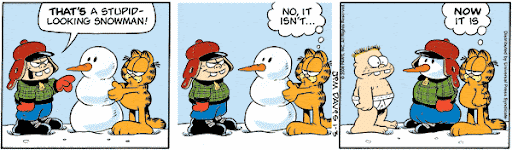


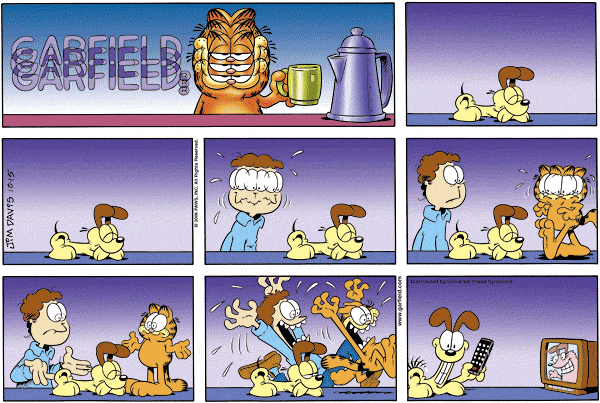

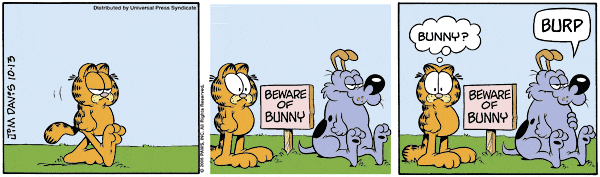
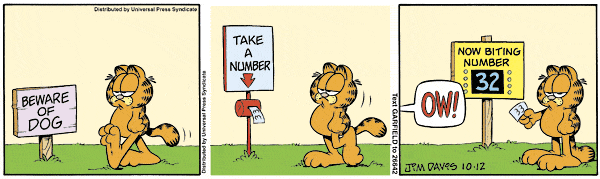
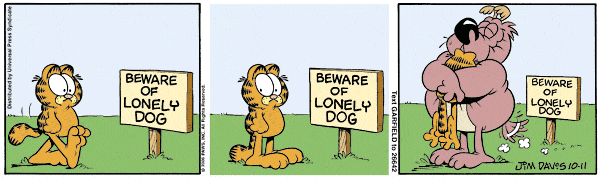
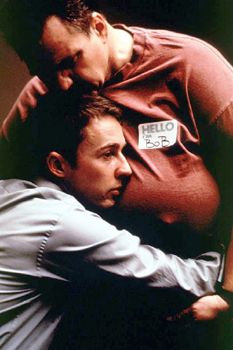 Affection in Garfield is an aggressive emotion, its most frequent expressions normally portrayed as unwelcome and overbearing. In its most common manifestations, we see Jon's desperation for love from Liz, and companionship and respect from Garfield, Odie's indiscriminate attacks of physical ardor, Nermal's narcissistic longing for praise and attention. This is not to say it is a negative, or destructive impulse, just that the infrequency of characters exhibiting reciprocity to caring and understanding give affection a specific power and commodity in the world as Garfield sees it. The means by which Garfield copes with this shortage is to channel desire into aesthetic passion for food, sleep, TV, flowers, etc., which he variously decimates or overindulges and exhausts the love-object. This is less self-delusory than an act of self-deprivation; in the interest of sustaining control over his surroundings and self, Garfield eliminates from his nature those desires which cannot be reliably self-fulfilled. In effort to maintain his Cool, love takes a backseat.