Saturday, September 16, 2006

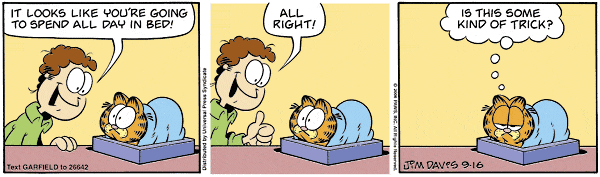
The Purr-ning Bed


Any casual acquaintanceship with Garfield will tell you that the cat spends heroic amounts of time sleeping, eating, watching TV and lazing because he loves doing these things, and hates denying himself anything. Too true, but unlike his cartoon glutton layabout forbearers like Jughead Jones, Shaggy Rogers, or Dagwood Bumstead, Garfield is not motivated solely by joie de vivre. A true divergent thinker, he also tends to take up an oppositional stance for the purpose of flustering others, bucking expectations, and making excuses to himself for his actions. In concrete terms, Garfield not only stays in bed all day because he is lazy/ has nothing to do, but because he knows it bothers Jon. Why it bothers Jon is another set of issues. For the most part we can assume that he sees in Garfield's refusal to get out of bed the futility of his daily life, an acceptance of laissez faire "why bother?" nihilism that Jon is not prepared to make.

Who knows what Jon is really up to, but Garfield is so entrenched in habits of manipulation that he can only assume that acceptance and support is the kind of scam he's used to pulling himself. The panic in Garfield's eyes when Jon seems to approve of the cat's plan to stay a-bed all day is that of a master reverse psychologist faced with his own tactic.

Friday, September 15, 2006

The G and Cake


I frequently point out how Garfield uses pride in his own shortcomings to cope with the world depicted in the strip. Which is not to say he doesn't receive the same punishments or suffer the same miseries as the rest of the characters (or the rest of humanity). He takes comfort in lack of adventure or any basic activity including movement by scoffing at its value, associates negativity with happiness, and boasts about things others would not even speak of, etc. Extending the tendency to its logical conclusion, Garfield often takes masochistic pleasure in misery itself, even when as experienced by himself; this doesn't relieve him from the circumstance of his existence, and other characters deal with the Garfield world in their own ways, but Garfield's defense mechanisms allows him to face it with less agony than Jon and more integrity than Odie.

So lest we think Garfield gets his comeuppance for his gluttony, when the expansion of soft baked goods fracture his skull into a perfect cylinder, think again. Part of the joke is the improbable ability of partially chewed cake to suddenly regain its shape, and several layers to spontaneously stack themselves with such force as to shatter cranial bone from the inside while powerful jaw-muscle pressure is being exerted on it. The other part of the gag, the real biting edge, has to do with Garfield refusing culpability for his gluttony and thievery. No, it is not Garfield's fault that he ate hot cake batter which he stole from the oven: not even bothering to twist logic, but leapfrog it entirely, this is Jon's fault.

Thursday, September 14, 2006

Cat Fight


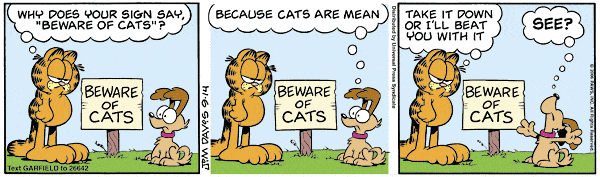
Garfield is a bully; all trickster characters who achieve special mastery over their universe (Bugs Bunny, Axel Foley, Brer Rabbit, etc.) press their intellectual advantages to some degree, and could technically be charged with emotional and mental bullying. But Garfield regularly physically assaults Jon, Odie, Nermal, spiders, mailmen and others when manipulation fails or is just too taxing for his liking. This is one of the qualities -- if not the quality -- that makes Garfield a uniquely and specifically American pop culture icon, and is the source of a lot of his power as an instrument of social criticism.

On one hand, we have the small, bitter ironies of a self-fulfilling prophecy: both the dog's sign (which in part inspires the cat to retaliate), and Garfield's threat (a cruel response to accusations of cruelty) elicit exactly the reply they were intended to avoid. The supreme comic contradiction of Garfield is his utter narcissism despite failing to manifest many positive characteristics. The masterstroke, as in Confederacy of Dunces, is to position the ill-tempered slob as the hero, by placing him in a world so screwed-up that his stubborn egoism looks like integrity. Whether that little gay dog takes the sign down or not (and who made that sign for him?), Garfield, ever a credit to his race, is going to pound the bejeezus out of him anyway.

Wednesday, September 13, 2006

Little Orange Lie


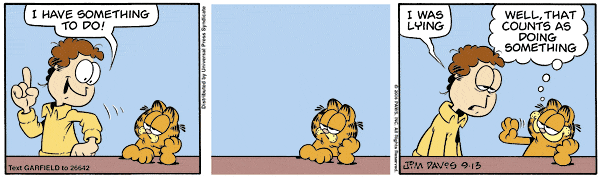
Garfield, that cartographer of barren landscapes of human existence, takes aim at anyone who thinks they can accomplish anything, achieve the smallest triumph, or even occupy their time in any meaningful way. Jon deludes himself and tries to lie to his cat (who is having none of it), that not only will his life be imbued with meaning by completion of tasks, but that he has such important occupations ahead of him. The enthusiasm of this announcement is perhaps the saddest, funniest thing in the strip, unless it's Garfield's knowing acceptance of an essentially empty existence in panel two. Only in Garfield is sloth to the point of pride in avoidance of any movement or responsibility equated with a kind of Zen perfection.

Garfield's assurance that the lowliest of human behaviors qualifies as an activity worth consideration is not totally inaccurate, but holds no comfort for Jon, who was surely looking for a way to inscribe positive meaning on his day. Now he has to look in the mirror and say "all I did today was lie to my cat, who didn't believe me in the first place." Confessing your shortcomings also counts as doing something.

Tuesday, September 12, 2006

Cat-tle and Hum


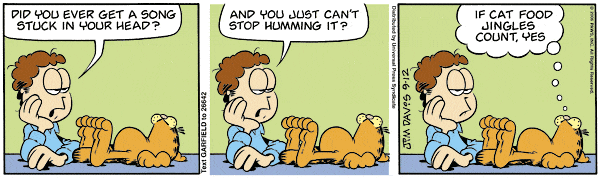
The most unlikely part of this dilemma is that he asks his cat if he ever hums. Everyone gets songs caught in their head. Everyone knows at least one cat food jingle, probably the Meow Mix song, because it is diabolically catchy and hilarious. I don't know if Alpo used to have a jingle of any note, but maybe Garfield also remembers that one from his endorsement deal back in the day. But Jon has been under a daily barrage of un-catlike behavior from Garfield, and constantly treats him as an equal. I love those moments when the unreality of this world becomes such a matter of course that Jon can just assume that Garfield has the ability to hum.

Mechanics of Garfield Thought Bubbles: Garfield is usually able to prompt Jon's disgusted sideways glance through meaningful silences and body language. Today a lack of verbal response and movement would indicate tot he casual reader that today violates the cardinal rule that Jon cannot hear Garfield's thoughts. Among the possibilities is a subtle version of: "Did I... really just ask my cat if he ever hums?"

Monday, September 11, 2006

If You Give a Mouse a Coffee


Garfield's imperviousness to abuse in the second panel lets us know something is "up", and then points out one of those funny rules life. That cheese is to mice as coffee is to humans, and, er, cats (and comics bloggers) is not the most crucial point. There are times in life we will forgive, or at least overlook, personal insults, short tempers, and general bad behavior, and one of them is excusing grumpiness in people who haven't had a cup of coffee. This grace period for manners is actually nice, and I wouldn't imply it is a hypocritical standard or anything; it's just funny. Garfield forgives the mouse for being rude out of a common courtesy, and explains this to us. Garfield feels no need, however, to explain why he regularly allows the far more outrageous lapse of manners toward his housemates, of allowing vermin to cavort around the house, and in fact encourages the mice to steal food. Lest we think Garfield is being too soft letting a mouse call him "Fatso," do not lose sight of the larger discourtesy he commits in the process.

Sunday, September 10, 2006

Jon Candy 2.0


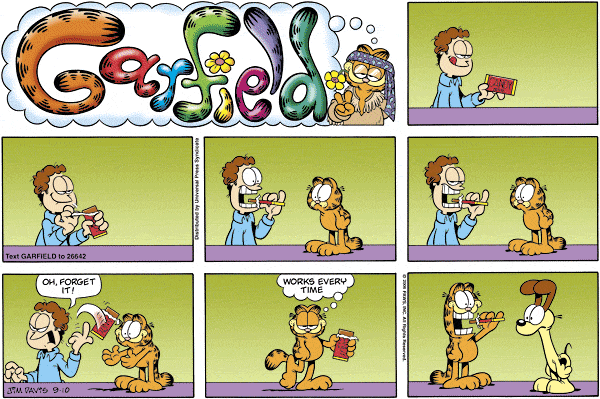
Title Panel: When Hippie Garfield hallucinates, he sees letters spelling out his own name and built of his own flesh. He is so self-involved that while pursuing enlightened states, he ends up deeper inside a maze of his own identity so encompassing it threatens to edge his physical form out of the frame.

The Journey of the Candy Bar: An allegory about the pleasure of anticipation, the power of guilt, and the eternal cycles that leave no hunger satisfied and no behavior rewarded. Though if we think about the individual characters, it is unlikely Odie has the power to guilt-trip Garfield into relinquishing the chocolate bar, Garfield sometimes (frequently on Sundays) asks the cast to enact jokes with full awareness of their own archetypes. The strip plays on the dynamic that Garfield will shamelessly steal Jon's food, and that Jon is so used to defeat in all things that he gives up without a fight. It also sets up an endless loop; these three have been through the scenario so many times, it's hardly about getting to enjoy the candy anymore. Nobody ever will; it's a Milk Chocolate Maltese Falcon. The power isn't with you because you have the material goods, and it's not in the McGuffin itself. It's in knowing you can wrest the chocolate from Jon at any time.

Saturday, September 09, 2006

The Jon-queror Worm


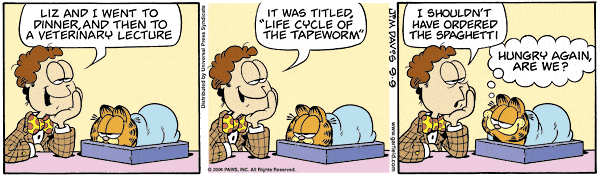
Jon consciously attempts to blind himself to any negative associations about time spent with Liz, only to crash back to reality. The intoxicating powers of romance can effect even those characters inhabiting a world as thick with ennui as Garfield, but the small happiness of time spent with a woman he likes is not enough for Jon. He has to build a scaffolding of self-delusion (look at that lost expression), and fight off even the tiniest unpleasantness. That the date activity was kind of poorly chosen is not a big deal, it's not a character flaw in Liz, and Jon's discomfort could've been avoided by better communication; part of this story is about a thin facade of perfection Jon puts up around Liz. Alternate reading: Jon's horror at the lecture was largely because being reminded of the vulnerability of household pets to tapeworms, i.e. the evening spent with Liz clarified the potential for repulsiveness deep inside his best friend.

The other part is about how Jon and Liz had a good time even though Jon was variously bored and disgusted during the medical lecture. Because while a lot of Garfield is about pointing out how empty and unhappy-making our culture is (Jon's 27 year string of failed dates, Garfield's TV-watching habits), a lot of it is about rooting out the small joys we root out of unexpected crevices. Maybe it's self-delusion in panels one and two... maybe Jon got a weird charge out of getting sick looking at pictures of gastrointestinal systems with his girlfriend. And if the Garfield audience laughed, then maybe we all did.

Q: What does Garfield's rejoinder mean? Is he sarcastically pointing out that since Jon is sick to his stomach he obviously wouldn't want to eat? Or is he implying Jon vomited, and may actually be hungry again? Why do I care about this tiny variable, when the overall meaning of the joke is the same?

Either way, it looks like Garfield is trying to sleep while Jon keeps him awake, babbling about his new girlfriend. The only part that catches his attention is about spaghetti. Who has their priorities in order?

Friday, September 08, 2006

Paws for News: Feeding Time & Trouble in Crustwood

Site Feed

Because of time wasted goofing around with Blogger Beta (Yawn! Nap attack!), Per-Mon got a even more behind than usual this week; I expect this will happen now and then. It is my understanding that newsfeeds do not update with backdated posts, so to avoid undue anxiety, I assure Atom subscribers that no day's strip will be skipped. If Permanent Monday gets behind, you can always check the blog and find the missing goodies.

Dinette SetScandal!

Sadly, to say nothing of ominously, Per-Mon's favorite daily comic strip criticism journal, Dinette Set Deconstruction has fallen under legal threats by singularly perplexing cartoonist Julie Larson. But hoorah, it moved to: Blather 'bout Burl, including the old archives but minus the strips. Viva critical theory!

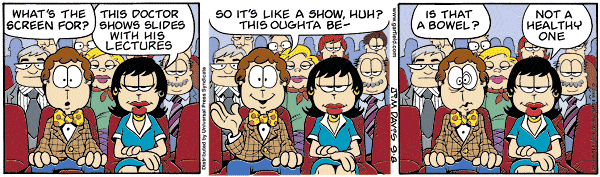
Throwing In The Bowel


Jon, Panel One: Childlike, questioning, possibly concerned about strange but certainly innocuous practices he does not understand, like "slide projection".

Liz, Panel One: Sweet, amused, slightly condescending in that approving way that only your mother or girlfriend is allowed to speak to you.

Jon, Panel Two: Though already excited for the lecture to begin, the promise of such minor embellishments as pictorial slides pushes the deal into entertainment territory for Jon. What sort of avant garde "shows" Jon is used to attending, I cannot say, though I do know he is easily shocked by exotic sights in motion pictures.

Liz, Panel Two: Knowing silence, as with all silences in Garfield, gives us special windows into characters. Anticipating the disaster of the next panel, and possibly just the refreshing company of a man thrilled by the prospect of slides.

Jon, Panel Three: Garfield Storytelling 101: Audience reaction is a funnier reveal than seeing a picture of a diseased intestine.

Liz, Panel Three: The moments when we can stomach repulsive sights our friends cannot is a small joy not documented often enough. Savor them. They bring us closer together, even when those moments include a woman's high tolerance for photos of rotten colons.

Recurring Gag: Jon has an unfortunate tendency to demonstrate willingness to participate in Liz's life by faking fascination with animals' excretory systems.

Thursday, September 07, 2006

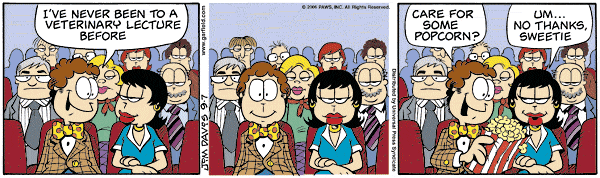
The Concession Stand: Complete and Unbuttered


In a room where even the vets in attendance look unhappy, and professional decorum is stifling any pre-lecture chat, Jon manages to amuse himself and his date. Jon's baseless enthusiasm and silly optimism (squelched easily enough though it may be; confidence is still not Jon's strong suite) are the same low-key, uncelebrated traits that get any of us through the day. In Jon they're a little heightened, and while not a man of burning Wuthering Heights passion, this is a good demonstration of Jon's appeal. Boyish enthusiasm, ability to make fun for oneself, and curiosity about new experiences, however minor are all are among the qualities in this man of little personality which I suspect Liz sees in him. Doubters would do well to ask themselves if they are fun-loving enough to bring their own big bag of theater popcorn to a medical lecture.

Veterinary Fashion Beat: In for Fall '06: extra-wide ties and neck scarves.

Wednesday, September 06, 2006

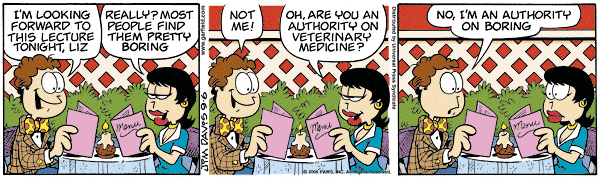
I'm So Bored With The AVMA


Jon does not simply observe that his typical night at home might be about as stultifying as listening to a professional address on a subject he knows nothing about. He suggests that his personal expertise might coincide with and enhance a perverse appreciation for the lecture. Jon's connoisseurship of dullness is a joke about the empty plains of his personal life, but when sized up next to the gradual triumph of cult, camp and divergent art criticism in the 20th century, it is not far-fetched. As Andy Warhol said, "I like boring things", an apparent contradiction (If you "like" it, can it be "boring"?) that bears an outrageous truth on its back. What is Warhol's greatest legacy, but a meta-joke he shared in common with Garfield?: the cultivation of ennui as a cultural commodity and pursuit unto itself. But there's a difference. Where Warhol ironically regurgitated the used-up spectacle of celebrity culture as a demonstration of how our preoccupations are hollow and malnourishing, Garfield never got worked up about anything in the first place. There is not an ironic turn when Jon explains why he's anticipating a lecture he won't understand.

Intricate discourse on hyperspecialized topics obviously interests me, and some days Garfield seems to comment or speak indirectly about the journey of Permanent Monday itself. It may not be that anyone reading is a Garfield expert. From the hate mail, I presume a large portion of the audience is not even Garfield fans. But during some lectures, it's not the topic itself.

Tuesday, September 05, 2006

Feignable Lecture


Jon begins his discovery of how being in a relationship can make one as profoundly unhappy as not having a girlfriend. Today (and potentially this story arc) is about the increasing phenomenon of being forced into things you don't want to do to spend time with someone you like. This factors into all intimate human relationships, but perhaps it is one of the primary differences between a girlfriend and a platonic friend: they expect more attention and indulgence. Not that Liz makes particular demands of Jon, and seems to be simply inviting him to the lecture if he feels like going; the telling moment is Jon's eagerness regarding all things Liz Wilson. He's beginning to lose both a sense of self and in the process of overdosing on Liz, risking the mystique of a new relationship by spending an increasing amount of time in activities that bore him. At some point the average person would begin associating the activity partner with the experience of boredom and disinterest, but luckily for Jon, his own hobbies lean toward the dull and/or nonexistent.

Garfield, it is good to know, is such a studied liar and so accustomed to zoning out while dullards babble at him, that he immediately knows how to handle the situation, and advises Jon thus. Garfield has also been so long and so deeply mired in boredom that he believes sincerity itself can be faked. One may wonder when Garfield, who tends to wear his heart on his sleeve and speak bluntly, would have cause to present a facade of interest; the answer is: every day that he bothers to get out of bed and face the world.

Monday, September 04, 2006

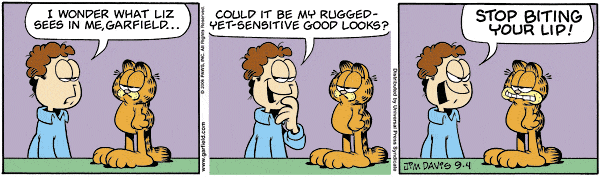
Cat Bites Lip


Biting his lip, presumably that he does not laugh or say (read: "think) a rude rebuttal. Jon obviously understands the signal anyway, and is hurt and angered, so if this were an attempt by Garfield to save Jon's feelings, it's backfired. In the instant karmic/insano-cosmic retribution of the Garfield-verse, your internal negative thoughts and judgment are going to shine through half-hearted attempts to be nice anyway, so why bother?

Or does Garfield really try to hold his tongue? Normally, snappy answers to Jon's stupid questions are Garfield's stock-in-trade, so why would he censor himself today? The cat is unable to speak, and in strip production considerations, having him laugh at Jon out loud was a gag used last week, but the requirements of the scene are that Jon lose his cool because he understands Garfield's thought. Garfield is able to convey skepticism and condescension through expressions normally signifying an attempt not to communicate, here the lip-biting ironically reveals more than Garfield could express without it (i.e. - he can't talk). And this, we may suspect, and surely Jon does as well, is a calculated move to have it both ways: Garfield gets to look like he didn't want to burst Jon's bubble, and gets to insult him by implication.

Bonus Funny: Man plagued by self-doubt even after new girlfriend gives him first confirmation of basic human worth in years, takes this problem to the source of most of his self-esteem issues.

Sunday, September 03, 2006

Pudd'nhead and Dr. Wilson


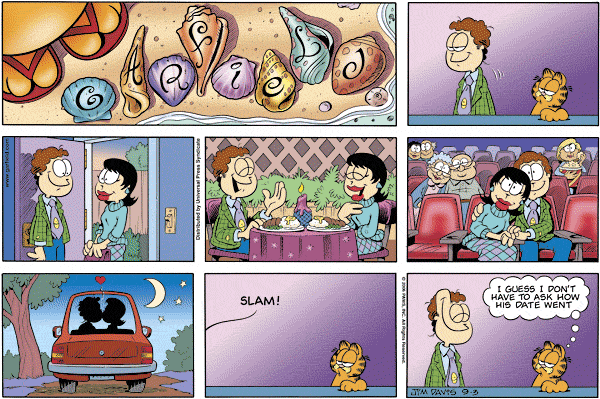
Jon rolls out the front door, and back in again after his date. The creepy part is not that Garfield has not moved over the course of several hours (he's barely moved over several years, after all), but that Jon is sliding around the house in a blissed-out love trance. Garfield can always tell how Jon's date went, because Jon is so expressive he either looks happy or like he's been hit by a train.

So again, the unsettling thing is that Garfield can normally count on Jon sharing all sundry details of his date, but Jon, driven to distraction, isn't speaking. In a way, he doesn't have to: the onset of twitterpation is one of the times the world can not only read you like a Denny's menu, but the world doesn't probably care to. Here is probably where Garfield's world will "change forever" (as we were promised by ballyhoo on garfield.com when Jon and Liz started dating. Garfield, rather than being glad for Jon, is disgusted with his idiotic, face-mutating grin. But do we sense something else? I think that undercurrent is not simple jealousy that Liz is taking up Jon's time, but not wanting Jon to be happy. Because Garfield likes to make jokes about Jon being a loser. Because Garfield has a perception of his friend that he wants Jon to live up to. Because Garfield needs a victim, an abuse object. And Garfield needs someone who needs him. That may be so he has the opportunity to withhold or dole out affection as he wishes, but it is endearing nonetheless.

Fan Edit Suggestion: The same story could have been told using only Panel One, and the last two frames. This would have preserved Garfield's determined lack of scenery, but robbed us of knowing how much Jon and Liz love seeing ill-attended movies after filling up on twin helpings of meatloaf.

Arbuckle Fashion Watch '06: It's great to see at least the blazer from the old Ugly Date Outfit back in action, after its recent banishment in favor of more dignified threads.

Saturday, September 02, 2006

Bad Day at Cat Rock


Garfield frequently takes pleasure, brags about, and shows off his bad behavior. Today he is amazed and held in thrall by the power of negative feelings to overwhelm and transform him. Similar to a recent gag in which Garfield finds amusement in his own boredom. To a point, Garfield always likes to wallow in negative emotions, which is why he insults those he cares about and frightens and hurts the innocent. But those are behaviors that allow him to victimize others to make himself feel powerful. There is a certain usually unspoken thrill in the feeling of giving way to damaging emotion (the comfort of feeling sorry for oneself, the adrenal rush of anger). To be sure, Garfield is feeling this in panel one. But by the end, where the cat is delighted by the physical transformation caused by grumpiness, and fascinated by his apparently unmotivated mood swings, he's degenerated into pure naval-gazing. He just finds everything he feels and does endlessly interesting, and wants to tell others about it. This is a testament to Garfield's dedicated brand of narcissism.

Panel Three: all tied up in thinking about his own mood, Garfield attempts to summon Jon from another room by "shouting" - i.e. thinking loudly at him.

Friday, September 01, 2006

Live Free or Lie Down, Roll Over


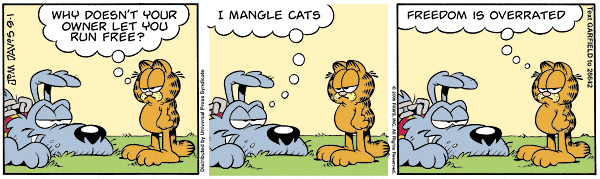
It's the kind of punchline whose brazen cynicism you have to admire, no matter what the political clime of the day. Garfield does not just propose that incarceration may be necessary when crimes have been committed. Nor is he saying that having personal freedoms stripped may be necessary when an individual proposes a substantial threat to the safety of society. Garfield says unrestricted liberty has been ignorantly championed, because it is dangerous.

Is Garfield really a fascist? I doubt it. His rebellious streak is too strong. Garfield's closing comments are usually to be read as sarcasm, and today is no different. "Freedom is overrated" is simultaneously the reasonable conclusion of fear of others, and the ill-reasoned results of a flawed premise. Since Garfield's goals are unambitious to start with, if we subtract the quotient of his cynicism and self-pity, the philosophy is better stated: YOUR freedom is overrated, while mine is sacred.

If one extrapolates Garfield's combined beliefs and desires to a logical conclusion, everything in all creation - except the fulfillment of basic hungers - is overrated. So don't be too shocked when that includes your dearest ideals.

Also: That dog's head is the size of Garfield, who is in turn half as tall as Jon. I know the joke is bolstered by a big dog, but is some kind of Ice Age terror-dog necessary?

Thursday, August 31, 2006

License to SNATCH


Panel One: A classic Garfield last-panel-reveal joke. These usually sustain our interest because of a character's inexplicable, strange behavior, or an out of place, unfamiliar element. Today we join the action midstream, and all the reader wonders is "what is Garfield taunting Jon about this time?"

Once we find out the answer and reevaluate the story, a new question is provoked: did Jon come home from the DMV and ask his cat's opinion of his new photo? Well of course he did.

Panel Two: Jon's arc through these three panels is not the simple embarrassment of a bad driver's license photo, but the dual-motivated surprise and hurt of ego deflation and betrayal by a confidant. Jon obviously thought the picture was either flattering, requested damage-assessment, or had handed over the card for unrelated inspection, and reacts as if not expecting this jarring outburst from Garfield. As Tweetie once said, "he don't know me very well, do he?"

Panel Three: Garfield's ironic appreciation of the photo because it embarrasses Jon has further weight than simple insult, because Garfield makes no effort to improve his personal appearance. Though the cat is outrageously vain, the quality is baseless pride, entirely delusional and narcissistic. When Garfield teases Jon about the photo, the taunt carries the implicit message that since he could not be wounded in the same way, Garfield is laughing at. Not with.

Also Garfield seems to inflate in size for no reason.

Wednesday, August 30, 2006

L'Ârge d'order of Pizza


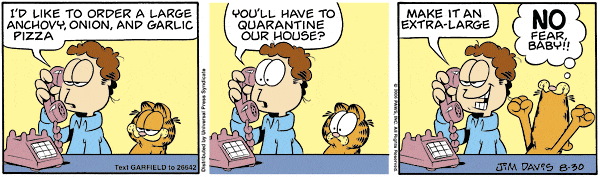
Garfield's "NO FEAR!" cheer, a proclamation of true grit normally applied to sporting contests and dangerous living, is incongruously applied to two guys who are going to eat as much gross pizza as possible. In the joke-logic world, the pizza toppings are so disgusting, or will render Garfield and Jon so smelly, that they actually will be a danger, and arguably gorging yourself on melted cheese is not the safest of dietary choices. This isn't actually far removed from normal Guy Behavior, where eating and drinking contests, and feats of consumption fuel good times and liver problems alike, all the time.

The slight difference is that Jon and Garfield, for no reason besides sheer contrarian mischief, decide to go for broke with their antisocial behavior. What else is there to do when your personal habits and desires — be it nasty pizza toppings, bad music, cigarettes, weird haircut — are being attacked? Even if social standards require only the smallest of personal compromise? Even if the reasons to cooperate are for entirely logical, understandable reasons? Garfield advises not only to let one's freak flag fly, but to crank up Here Comes Garfield and blow smoke in the face of oppression. Of course, this only applies when personal appetite is at stake. This is less War on Freedom than "Don't Crowd Me".

Show me the ultimate end-product of American individualism, and I'll show you a cat with garlic breath.

Tuesday, August 29, 2006

On Top of the Table and Dreaming


The key to Garfield's personality is not that he is simply lazy and grouchy, but his determination to be as lazy as possible. He doesn't just space out like a normal person, but plans and makes an effort to space out. Understanding this is critical to appreciating Garfield in general. It's not boring, but a hard look at what boredom means, and the damages and comforts we may find there.

As the joke in a newspaper comic strip, Garfield examines what audiences demand in popular entertainment; it should be new and thrilling, but please, more of what we're already familiar with. It also reminds us of the special pitfalls of writing Garfield: when the point is that nothing ever happens, how does one continually engage an audience?

"I want to do absolutely nothing, but I want it to be a new absolutely nothing." The paradox is the joke, but Garfield's dilemma makes a sharp observation about a fundamental reason people are miserable. The unresolvable, eternal tension between desire for excitement and need for comfort. Garfield mocks the heightened conflict of other fiction by inventing a hero whose irritation threshold is so low that he can't help but have his plans foiled. What happens to a life that pursues ennui believing it to be fulfillment?: eventually, Garfield sees the ricocheting effect as he stares into the void; he runs out of dreams. In Garfield, the universe itself is so fundamentally barren that even a creature who bores himself for entertainment is frustrated in his effort. The oh-so-Garfield response to this ultimate spiritual crisis?: "Nuts."